

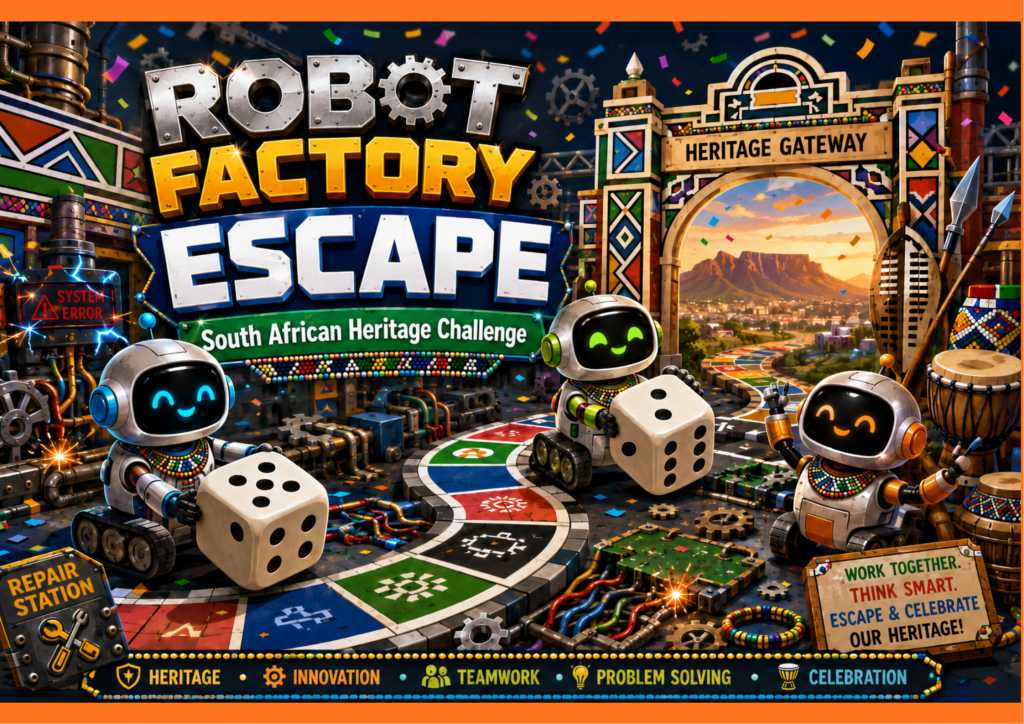
Our project, Robot Factory Escape, is an interactive board game that combines coding, teamwork, and South African cultural knowledge. Players work together to help their robot escape a factory by moving around the game board, answering heritage quiz questions, and using a Micro:bit as a digital dice and timer. The project was designed to make learning about South African culture fun and engaging while introducing learners to coding and computational thinking.
Project Statement
Many learners find it difficult to learn about South African heritage in an interactive and enjoyable way. Our community needs a game that combines technology with education because it encourages teamwork, critical thinking, and a greater appreciation for our country's rich history and diverse cultures. Robot Factory Escape allows players to explore South African heritage while solving challenges and working together to escape the factory.
Target Users
Our project is designed for:
- Learners in primary and high school.
- Teachers who want an engaging educational activity.
- Families looking for a fun learning game.
- Tourists or visitors who want to learn more about South African heritage.
How it works
Robot Factory Escape is played by four players, with two players on each team. Each team is given one Micro:bit, which is used as a digital dice and a 30-second countdown timer.
Teams take turns pressing Button A on the micro:bit to roll a random number (dice) and move their game piece around the board. Button B will be the timer used for the 30-second quiz. Along the way, players may land on special challenge spaces that test their knowledge of South African heritage or trigger factory hazards.
The special spaces work as follows:
- Spaces 3, 6, 9, and 21 – Heritage Quiz
- The team answers a South African cultural question.
- If the answer is correct, they move 2 spaces forward.
- If the answer is incorrect, they move 3 spaces backward.
- Space 18 – Timed Heritage Challenge
- The team has 30 seconds (timed using the Micro:bit) to answer a South African cultural question.
- If the answer is correct, they move 5 spaces forward.
- If the answer is incorrect or time runs out, they move 7 spaces backward.
- Space 13 – Factory Malfunction
- The robot experiences a factory malfunction.
- The team must move 13 spaces backward.
The game continues until one team successfully reaches the Exit and escapes the factory. The combination of coding, teamwork, and cultural quiz challenges makes the game both educational and exciting while promoting knowledge of South African heritage.
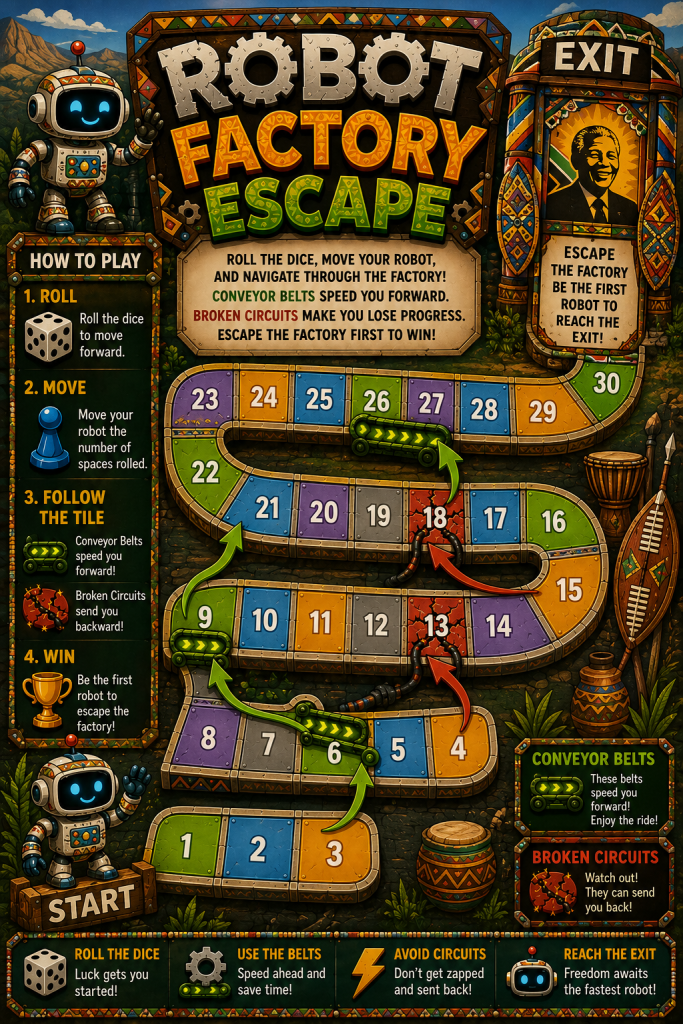
The rules
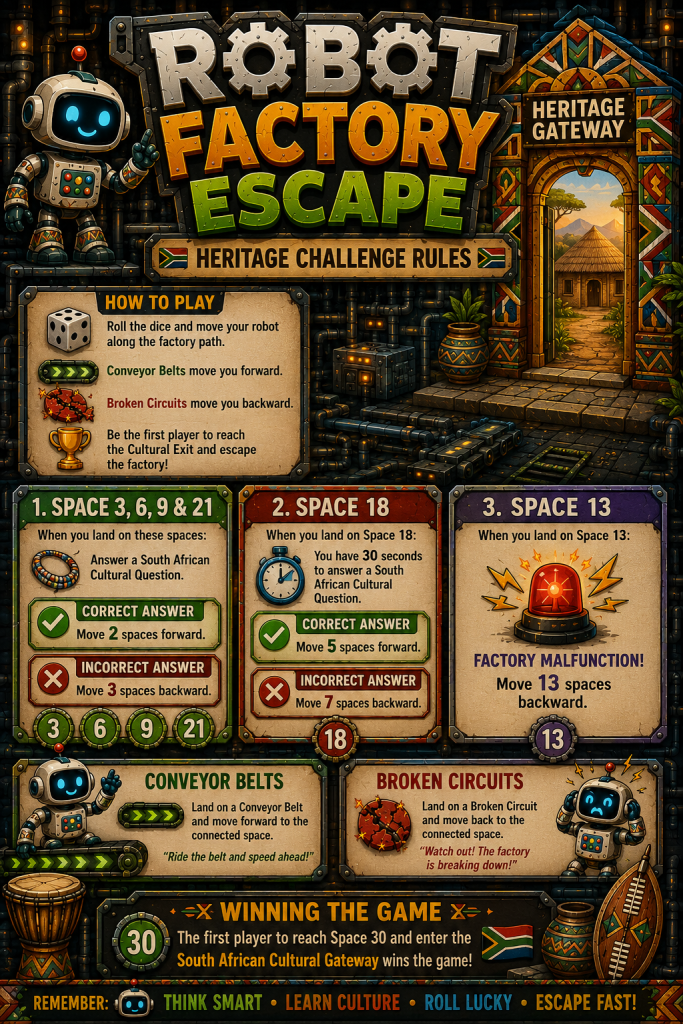
Understanding how the micro:bit will be used
Inputs
- Button A to roll the digital dice.
- Button B to start the 30-second timer.
- Player button presses to control the Micro:bit.
Outputs
The game continues based on the quiz results.
The Micro:bit displays a random dice number.
The countdown timer is shown on the LED display.
Sounds play when the timer starts or ends.
Computational Thinking
Decomposition
We divided the project into smaller tasks: creating the board game, programming the digital dice, creating the timer, designing the heritage quiz cards, and writing the game rules.
Pattern Recognition
We recognised that every turn follows the same pattern: roll the dice, move the robot, check the square, complete a challenge if required, and continue until reaching the finish.
Algorithm Design
The Micro:bit waits for the player to press Button A to generate a random dice number. The player moves their robot accordingly. If they land on spaces 3, 6, 9, or 21, Button B starts a 30-second timer. The team answers three South African heritage questions, and depending on their score, they either move forward or backwards before the next team's turn begins.
Debugging
We tested our program several times to make sure the dice generated random numbers correctly, the timer counted down accurately, the sounds played at the correct times, and the game followed the correct movement rules. Any errors were fixed by checking the code and testing each feature until it worked as expected.